

From Classroom to Career: How Hands-On Learning is Shaping Sam Rodgers’ Path
January 14, 2026
From Stream Banks to the Lab: How One Grant Powers Warwick Science
April 8, 2026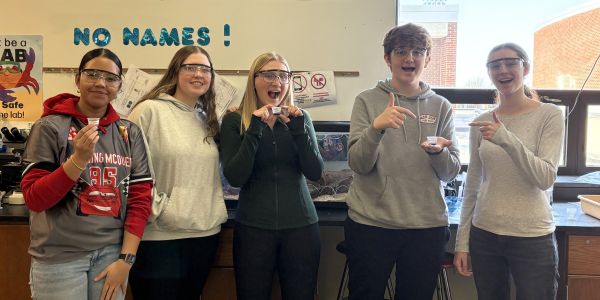
Stacking STEELS Learning: When Students Start Feeling Like Scientists
In a Warwick biology classroom, curiosity hums louder than the lab equipment. Beakers bubble, sensors glow, and questions fill the air. Then a student looks up and says, “I actually feel like a scientist.”
That’s exactly what’s happening across Warwick High School, with the help of the Stacking STEELS Learning grant funded by the Warwick Education Foundation.
This year, Warwick classrooms fully transitioned to Pennsylvania’s STEELS (Science, Technology, Engineering, Environmental Literacy, and Sustainability) Standards – the new academic standards for science education. With them came new topics and opportunities for inquiry-driven learning.
For biology teacher Krista Roe, the shift was both a challenge and an invitation. “Carbon cycling and feedback loops were added in the curriculum, but we had no hands-on labs to supplement and enhance student learning. That’s why I applied for the Stacking STEELS grant,” she explained.
With the grant’s support, Warwick biology students now explore two new inquiry-based labs: one modeling blood sugar regulation in the human body, the other simulating the carbon cycle and its role in the greenhouse effect.
In these labs, students build models, collect data, and interpret real outcomes. They see how rising temperatures intensify the greenhouse effect, and they test how mechanisms work in blood sugar regulation, making the connection to what happens when that system fails in diseases like diabetes. (See photos on our Facebook post HERE.)
“These labs take abstract concepts and put the learning in the hands of students. They connect what we’re learning to real-life experiences,” explained Krista.
Sometimes, the most powerful learning moments come when things don’t go perfectly. During one carbon cycle lab, a group’s setup wasn’t sealed properly, allowing carbon dioxide to escape and altering their results. Instead of viewing it as a failure, the class analyzed what went wrong and how to improve their approach next time.
That’s when a student said, “I actually feel like I am a scientist.”
This is the goal. Because science isn’t all about memorizing terms. It’s about asking questions, testing ideas, analyzing data, and refining methods. It’s about understanding the world and your place in it.
Thank you to our generous donors who supported this grant and helped Warwick biology teachers do more than adapt to new standards; they elevated them.
Learn how you can help support Warwick students here.
****